> ## Documentation Index
> Fetch the complete documentation index at: https://docs.comfy.org/llms.txt
> Use this file to discover all available pages before exploring further.
# Ksampler - ComfyUI Built-in Node Documentation
> The Ksampler node is a commonly used sampling node in ComfyUI.
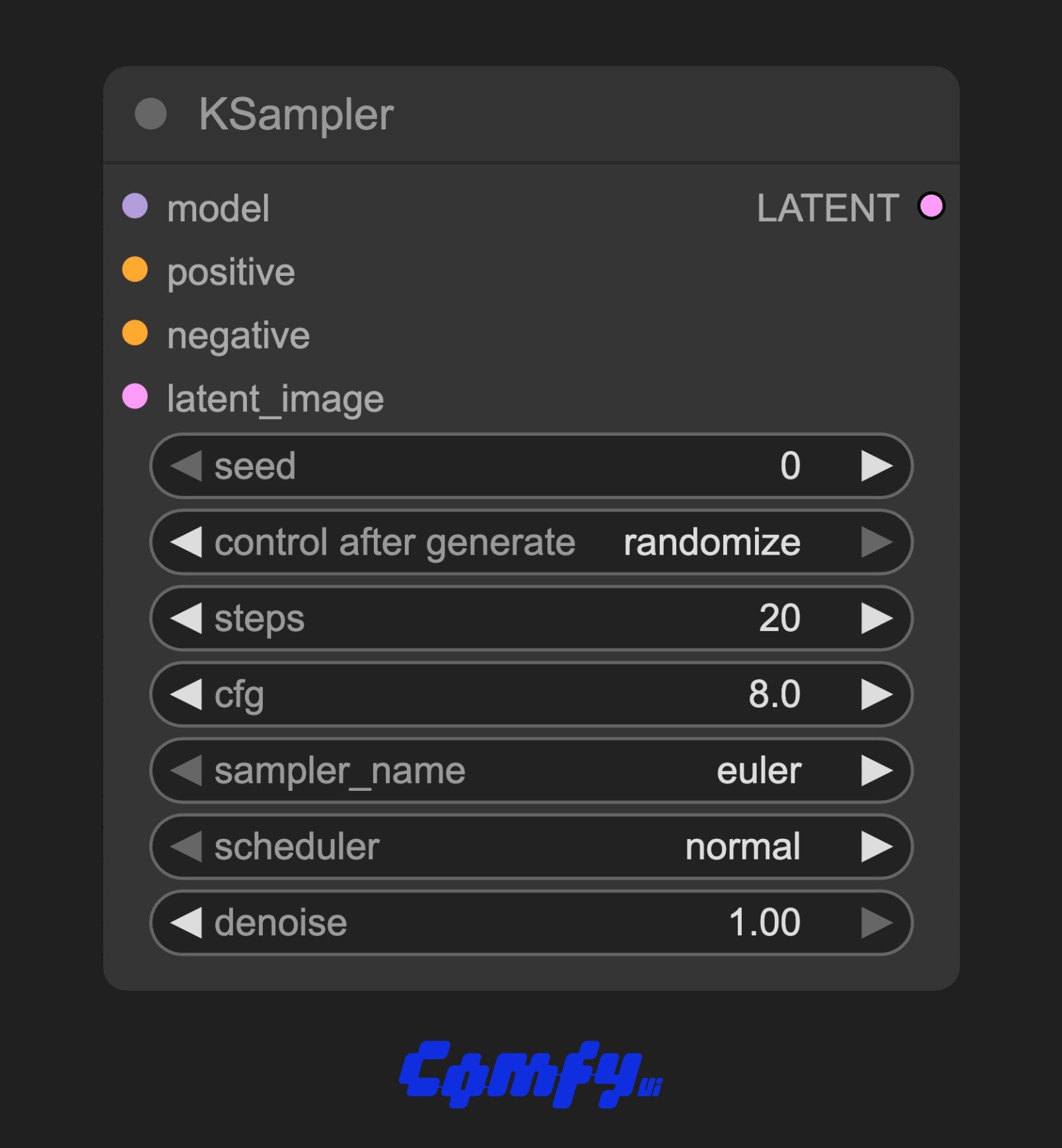 The KSampler node performs multi-step denoising sampling on latent images. It combines positive and negative conditions (prompts) and uses specified sampling algorithms and schedulers to generate high-quality latent images. It is commonly used in AI image generation workflows like text-to-image and image-to-image.
## Parameter Description
### Input Parameters
| Parameter | Type | Required | Default | Description |
| ------------- | ------------ | -------- | ------- | ------------------------------------------------------------------------------------------------------------------ |
| model | MODEL | Yes | None | Model used for denoising (e.g. Stable Diffusion model) |
| seed | INT | Yes | 0 | Random seed to ensure reproducible results |
| steps | INT | Yes | 20 | Number of denoising steps - more steps mean finer details but slower generation |
| cfg | FLOAT | Yes | 8.0 | Classifier-Free Guidance scale - higher values better match prompts but too high impacts quality |
| sampler\_name | Enum | Yes | None | Name of sampling algorithm, affects generation speed, style and quality |
| scheduler | Enum | Yes | None | Scheduler that controls the noise removal process |
| positive | CONDITIONING | Yes | None | Positive conditions describing desired image content |
| negative | CONDITIONING | Yes | None | Negative conditions describing content to exclude |
| latent\_image | LATENT | Yes | None | Latent image to denoise, usually noise or output from previous step |
| denoise | FLOAT | Yes | 1.0 | Denoising strength - 1.0 for full denoising, lower values preserve original structure, suitable for image-to-image |
### Output Parameters
| Output | Type | Description |
| ------- | ------ | -------------------------------------------------------- |
| samples | LATENT | Denoised latent image that can be decoded to final image |
## Usage Examples
Stable diffusion 1.5 Text-to-Image Workflow Example
Stable diffusion 1.5 Image-to-Image Workflow Example
## Source Code
\[Updated on May 15, 2025]
```Python theme={null}
def common_ksampler(model, seed, steps, cfg, sampler_name, scheduler, positive, negative, latent, denoise=1.0, disable_noise=False, start_step=None, last_step=None, force_full_denoise=False):
latent_image = latent["samples"]
latent_image = comfy.sample.fix_empty_latent_channels(model, latent_image)
if disable_noise:
noise = torch.zeros(latent_image.size(), dtype=latent_image.dtype, layout=latent_image.layout, device="cpu")
else:
batch_inds = latent["batch_index"] if "batch_index" in latent else None
noise = comfy.sample.prepare_noise(latent_image, seed, batch_inds)
noise_mask = None
if "noise_mask" in latent:
noise_mask = latent["noise_mask"]
callback = latent_preview.prepare_callback(model, steps)
disable_pbar = not comfy.utils.PROGRESS_BAR_ENABLED
samples = comfy.sample.sample(model, noise, steps, cfg, sampler_name, scheduler, positive, negative, latent_image,
denoise=denoise, disable_noise=disable_noise, start_step=start_step, last_step=last_step,
force_full_denoise=force_full_denoise, noise_mask=noise_mask, callback=callback, disable_pbar=disable_pbar, seed=seed)
out = latent.copy()
out["samples"] = samples
return (out, )
class KSampler:
@classmethod
def INPUT_TYPES(s):
return {
"required": {
"model": ("MODEL", {"tooltip": "The model used for denoising the input latent."}),
"seed": ("INT", {"default": 0, "min": 0, "max": 0xffffffffffffffff, "control_after_generate": True, "tooltip": "The random seed used for creating the noise."}),
"steps": ("INT", {"default": 20, "min": 1, "max": 10000, "tooltip": "The number of steps used in the denoising process."}),
"cfg": ("FLOAT", {"default": 8.0, "min": 0.0, "max": 100.0, "step":0.1, "round": 0.01, "tooltip": "The Classifier-Free Guidance scale balances creativity and adherence to the prompt. Higher values result in images more closely matching the prompt however too high values will negatively impact quality."}),
"sampler_name": (comfy.samplers.KSampler.SAMPLERS, {"tooltip": "The algorithm used when sampling, this can affect the quality, speed, and style of the generated output."}),
"scheduler": (comfy.samplers.KSampler.SCHEDULERS, {"tooltip": "The scheduler controls how noise is gradually removed to form the image."}),
"positive": ("CONDITIONING", {"tooltip": "The conditioning describing the attributes you want to include in the image."}),
"negative": ("CONDITIONING", {"tooltip": "The conditioning describing the attributes you want to exclude from the image."}),
"latent_image": ("LATENT", {"tooltip": "The latent image to denoise."}),
"denoise": ("FLOAT", {"default": 1.0, "min": 0.0, "max": 1.0, "step": 0.01, "tooltip": "The amount of denoising applied, lower values will maintain the structure of the initial image allowing for image to image sampling."}),
}
}
RETURN_TYPES = ("LATENT",)
OUTPUT_TOOLTIPS = ("The denoised latent.",)
FUNCTION = "sample"
CATEGORY = "sampling"
DESCRIPTION = "Uses the provided model, positive and negative conditioning to denoise the latent image."
def sample(self, model, seed, steps, cfg, sampler_name, scheduler, positive, negative, latent_image, denoise=1.0):
return common_ksampler(model, seed, steps, cfg, sampler_name, scheduler, positive, negative, latent_image, denoise=denoise)
```
The KSampler node performs multi-step denoising sampling on latent images. It combines positive and negative conditions (prompts) and uses specified sampling algorithms and schedulers to generate high-quality latent images. It is commonly used in AI image generation workflows like text-to-image and image-to-image.
## Parameter Description
### Input Parameters
| Parameter | Type | Required | Default | Description |
| ------------- | ------------ | -------- | ------- | ------------------------------------------------------------------------------------------------------------------ |
| model | MODEL | Yes | None | Model used for denoising (e.g. Stable Diffusion model) |
| seed | INT | Yes | 0 | Random seed to ensure reproducible results |
| steps | INT | Yes | 20 | Number of denoising steps - more steps mean finer details but slower generation |
| cfg | FLOAT | Yes | 8.0 | Classifier-Free Guidance scale - higher values better match prompts but too high impacts quality |
| sampler\_name | Enum | Yes | None | Name of sampling algorithm, affects generation speed, style and quality |
| scheduler | Enum | Yes | None | Scheduler that controls the noise removal process |
| positive | CONDITIONING | Yes | None | Positive conditions describing desired image content |
| negative | CONDITIONING | Yes | None | Negative conditions describing content to exclude |
| latent\_image | LATENT | Yes | None | Latent image to denoise, usually noise or output from previous step |
| denoise | FLOAT | Yes | 1.0 | Denoising strength - 1.0 for full denoising, lower values preserve original structure, suitable for image-to-image |
### Output Parameters
| Output | Type | Description |
| ------- | ------ | -------------------------------------------------------- |
| samples | LATENT | Denoised latent image that can be decoded to final image |
## Usage Examples
Stable diffusion 1.5 Text-to-Image Workflow Example
Stable diffusion 1.5 Image-to-Image Workflow Example
## Source Code
\[Updated on May 15, 2025]
```Python theme={null}
def common_ksampler(model, seed, steps, cfg, sampler_name, scheduler, positive, negative, latent, denoise=1.0, disable_noise=False, start_step=None, last_step=None, force_full_denoise=False):
latent_image = latent["samples"]
latent_image = comfy.sample.fix_empty_latent_channels(model, latent_image)
if disable_noise:
noise = torch.zeros(latent_image.size(), dtype=latent_image.dtype, layout=latent_image.layout, device="cpu")
else:
batch_inds = latent["batch_index"] if "batch_index" in latent else None
noise = comfy.sample.prepare_noise(latent_image, seed, batch_inds)
noise_mask = None
if "noise_mask" in latent:
noise_mask = latent["noise_mask"]
callback = latent_preview.prepare_callback(model, steps)
disable_pbar = not comfy.utils.PROGRESS_BAR_ENABLED
samples = comfy.sample.sample(model, noise, steps, cfg, sampler_name, scheduler, positive, negative, latent_image,
denoise=denoise, disable_noise=disable_noise, start_step=start_step, last_step=last_step,
force_full_denoise=force_full_denoise, noise_mask=noise_mask, callback=callback, disable_pbar=disable_pbar, seed=seed)
out = latent.copy()
out["samples"] = samples
return (out, )
class KSampler:
@classmethod
def INPUT_TYPES(s):
return {
"required": {
"model": ("MODEL", {"tooltip": "The model used for denoising the input latent."}),
"seed": ("INT", {"default": 0, "min": 0, "max": 0xffffffffffffffff, "control_after_generate": True, "tooltip": "The random seed used for creating the noise."}),
"steps": ("INT", {"default": 20, "min": 1, "max": 10000, "tooltip": "The number of steps used in the denoising process."}),
"cfg": ("FLOAT", {"default": 8.0, "min": 0.0, "max": 100.0, "step":0.1, "round": 0.01, "tooltip": "The Classifier-Free Guidance scale balances creativity and adherence to the prompt. Higher values result in images more closely matching the prompt however too high values will negatively impact quality."}),
"sampler_name": (comfy.samplers.KSampler.SAMPLERS, {"tooltip": "The algorithm used when sampling, this can affect the quality, speed, and style of the generated output."}),
"scheduler": (comfy.samplers.KSampler.SCHEDULERS, {"tooltip": "The scheduler controls how noise is gradually removed to form the image."}),
"positive": ("CONDITIONING", {"tooltip": "The conditioning describing the attributes you want to include in the image."}),
"negative": ("CONDITIONING", {"tooltip": "The conditioning describing the attributes you want to exclude from the image."}),
"latent_image": ("LATENT", {"tooltip": "The latent image to denoise."}),
"denoise": ("FLOAT", {"default": 1.0, "min": 0.0, "max": 1.0, "step": 0.01, "tooltip": "The amount of denoising applied, lower values will maintain the structure of the initial image allowing for image to image sampling."}),
}
}
RETURN_TYPES = ("LATENT",)
OUTPUT_TOOLTIPS = ("The denoised latent.",)
FUNCTION = "sample"
CATEGORY = "sampling"
DESCRIPTION = "Uses the provided model, positive and negative conditioning to denoise the latent image."
def sample(self, model, seed, steps, cfg, sampler_name, scheduler, positive, negative, latent_image, denoise=1.0):
return common_ksampler(model, seed, steps, cfg, sampler_name, scheduler, positive, negative, latent_image, denoise=denoise)
```