

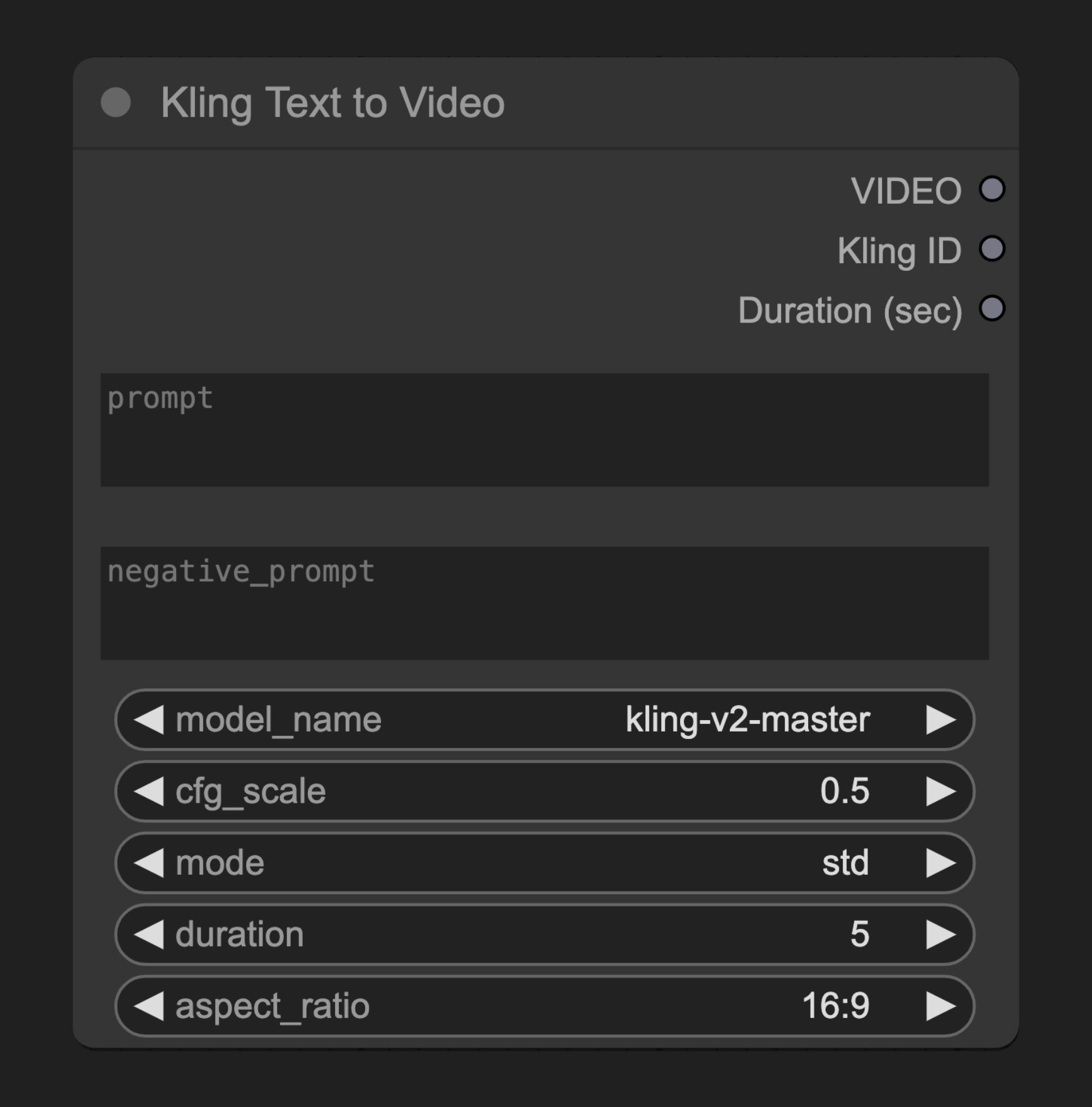
Parameters
Required Parameters
| Parameter | Type | Default | Description |
|---|---|---|---|
| prompt | String | "" | Text prompt describing desired video content |
| negative_prompt | String | "" | Elements to avoid in the video |
| cfg_scale | Float | 7.0 | Controls how closely to follow the prompt |
| model_name | Select | ”kling-v2-master” | Video generation model to use |
| aspect_ratio | Select | AspectRatio enum | Output video aspect ratio |
| duration | Select | Duration enum | Length of generated video |
| mode | Select | Mode enum | Video generation mode |
Output
| Output | Type | Description |
|---|---|---|
| VIDEO | Video | Generated video |
| Kling ID | String | Task identifier |
| Duration (sec) | String | Video length in seconds |
How It Works
The node sends text prompts to Kling’s API server, which processes and returns the generated video. The process includes initial request and status polling. When complete, the node downloads and outputs the video. Users can control the generation by adjusting parameters like negative prompts, configuration scale, and video properties. The system validates prompt length to ensure API compliance.Source Code
[Node Source Code (Updated 2025-05-03)]
class KlingTextToVideoNode(KlingNodeBase):
    """Kling Text to Video Node"""

    @staticmethod
    def poll_for_task_status(task_id: str, auth_token: str) -> KlingText2VideoResponse:
        """Polls the Kling API endpoint until the task reaches a terminal state."""
        polling_operation = PollingOperation(
            poll_endpoint=ApiEndpoint(
                path=f"{PATH_TEXT_TO_VIDEO}/{task_id}",
                method=HttpMethod.GET,
                request_model=EmptyRequest,
                response_model=KlingText2VideoResponse,
            ),
            completed_statuses=[
                TaskStatus.succeed.value,
            ],
            failed_statuses=[TaskStatus.failed.value],
            status_extractor=lambda response: (
                response.data.task_status.value
                if response.data and response.data.task_status
                else None
            ),
            auth_token=auth_token,
        )
        return polling_operation.execute()

    @classmethod
    def INPUT_TYPES(s):
        return {
            "required": {
                "prompt": model_field_to_node_input(
                    IO.STRING, KlingText2VideoRequest, "prompt", multiline=True
                ),
                "negative_prompt": model_field_to_node_input(
                    IO.STRING, KlingText2VideoRequest, "negative_prompt", multiline=True
                ),
                "model_name": model_field_to_node_input(
                    IO.COMBO,
                    KlingText2VideoRequest,
                    "model_name",
                    enum_type=ModelName,
                    default="kling-v2-master",
                ),
                "cfg_scale": model_field_to_node_input(
                    IO.FLOAT, KlingText2VideoRequest, "cfg_scale"
                ),
                "mode": model_field_to_node_input(
                    IO.COMBO, KlingText2VideoRequest, "mode", enum_type=Mode
                ),
                "duration": model_field_to_node_input(
                    IO.COMBO, KlingText2VideoRequest, "duration", enum_type=Duration
                ),
                "aspect_ratio": model_field_to_node_input(
                    IO.COMBO,
                    KlingText2VideoRequest,
                    "aspect_ratio",
                    enum_type=AspectRatio,
                ),
            },
            "hidden": {"auth_token": "AUTH_TOKEN_COMFY_ORG"},
        }

    RETURN_TYPES = ("VIDEO", "STRING", "STRING")
    RETURN_NAMES = ("VIDEO", "Kling ID", "Duration (sec)")
    DESCRIPTION = "Kling Text to Video Node"

    def api_call(
        self,
        prompt: str,
        negative_prompt: str,
        model_name: str,
        cfg_scale: float,
        mode: str,
        duration: int,
        aspect_ratio: str,
        camera_control: Optional[CameraControl] = None,
        auth_token: Optional[str] = None,
    ) -> tuple[VideoFromFile, str, str]:
        validate_prompts(prompt, negative_prompt, MAX_PROMPT_LENGTH_T2V)
        initial_operation = SynchronousOperation(
            endpoint=ApiEndpoint(
                path=PATH_TEXT_TO_VIDEO,
                method=HttpMethod.POST,
                request_model=KlingText2VideoRequest,
                response_model=KlingText2VideoResponse,
            ),
            request=KlingText2VideoRequest(
                prompt=prompt if prompt else None,
                negative_prompt=negative_prompt if negative_prompt else None,
                duration=Duration(duration),
                mode=Mode(mode),
                model_name=ModelName(model_name),
                cfg_scale=cfg_scale,
                aspect_ratio=AspectRatio(aspect_ratio),
                camera_control=camera_control,
            ),
            auth_token=auth_token,
        )

        initial_response = initial_operation.execute()
        if not is_valid_initial_response(initial_response):
            error_msg = f"Kling initial request failed. Code: {initial_response.code}, Message: {initial_response.message}, Data: {initial_response.data}"
            logging.error(error_msg)
            raise KlingApiError(error_msg)

        task_id = initial_response.data.task_id
        final_response = self.poll_for_task_status(task_id, auth_token)
        if not is_valid_video_response(final_response):
            error_msg = (
                f"Kling task {task_id} succeeded but no video data found in response."
            )
            logging.error(error_msg)
            raise KlingApiError(error_msg)

        video = final_response.data.task_result.videos[0]
        logging.debug("Kling task %s succeeded. Video URL: %s", task_id, video.url)
        return (
            download_url_to_video_output(video.url),
            str(video.id),
            str(video.duration),
        )