

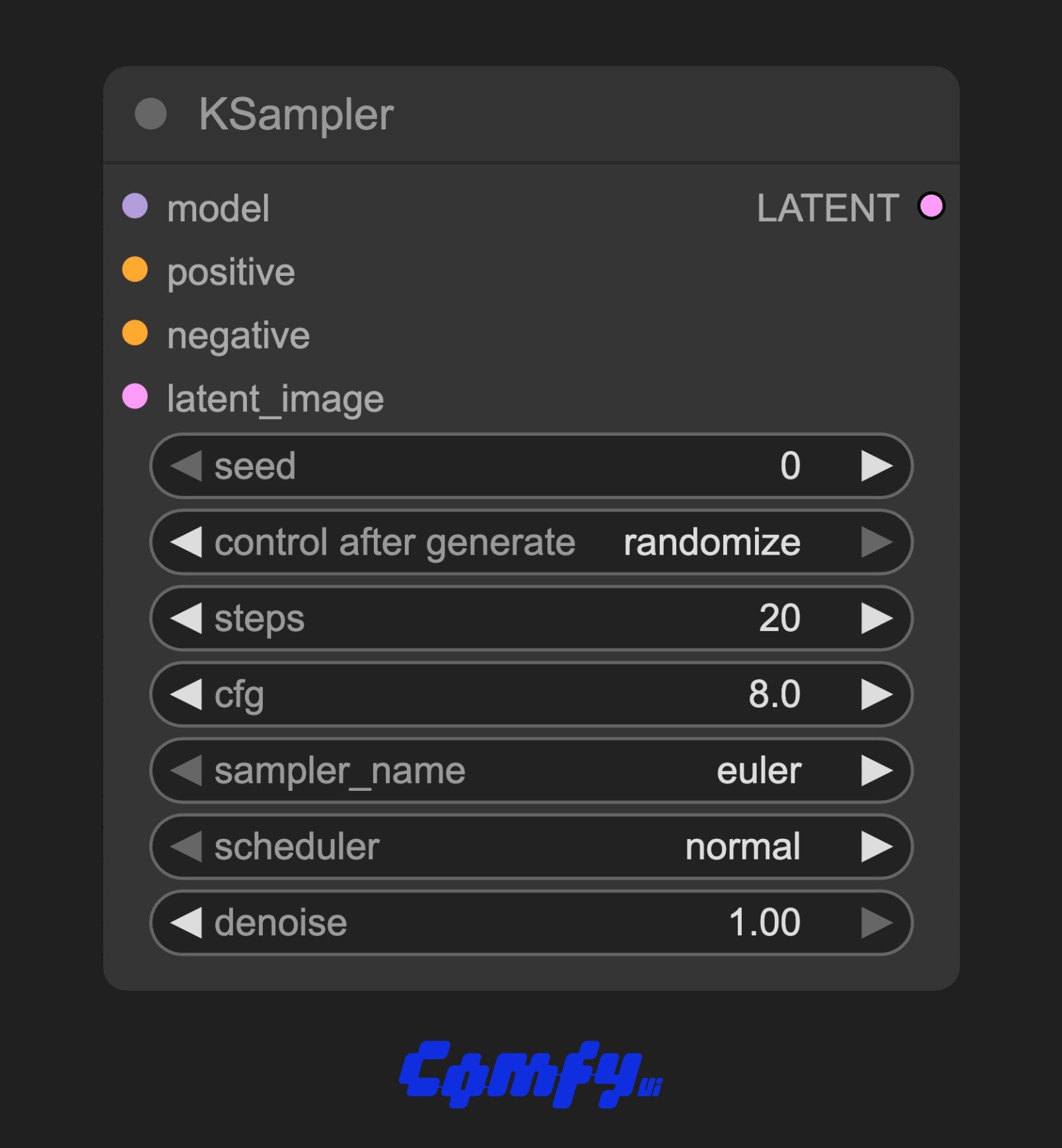
パラメータの説明
入力パラメータ
| パラメータ | 型 | 必須 | デフォルト値 | 説明 |
|---|---|---|---|---|
| model | MODEL | はい | なし | デノイズに使用するモデル(例:Stable Diffusion モデル) |
| seed | INT | はい | 0 | 再現可能な結果を保証するための乱数シード |
| steps | INT | はい | 20 | デノイズステップ数 — ステップ数が多いほど細部が精巧になりますが、生成速度は遅くなります |
| cfg | FLOAT | はい | 8.0 | Classifier-Free Guidance(CFG)スケール — 数値が高いほどプロンプトへの適合度が向上しますが、高すぎると画質に悪影響が出ます |
| sampler_name | 列挙型(Enum) | はい | なし | サンプリングアルゴリズムの名前。生成速度、スタイル、画質に影響を与えます |
| scheduler | 列挙型(Enum) | はい | なし | ノイズ除去プロセスを制御するスケジューラ |
| positive | CONDITIONING | はい | なし | 生成画像に含めたい内容を記述する正の条件(プロンプト) |
| negative | CONDITIONING | はい | なし | 生成画像から除外したい内容を記述する負の条件(プロンプト) |
| latent_image | LATENT | はい | なし | デノイズ対象の潜在画像。通常はノイズまたは前段の処理出力です |
| denoise | FLOAT | はい | 1.0 | デノイズ強度 — 1.0 では完全なデノイズが行われ、値を下げると元の構造が保持され、画像から画像への変換(image-to-image)に適しています |
出力パラメータ
| 出力名 | 型 | 説明 |
|---|---|---|
| samples | LATENT | デノイズ済みの潜在画像。最終的な画像へデコードできます。 |
使用例
Stable diffusion 1.5 のテキストから画像を生成するワークフローの例
Stable diffusion 1.5 のテキストから画像を生成するワークフローの例
Stable diffusion 1.5 の画像から画像を生成するワークフローの例
Stable diffusion 1.5 の画像から画像を生成するワークフローの例
ソースコード
[2025年5月15日更新]
def common_ksampler(model, seed, steps, cfg, sampler_name, scheduler, positive, negative, latent, denoise=1.0, disable_noise=False, start_step=None, last_step=None, force_full_denoise=False):
    latent_image = latent["samples"]
    latent_image = comfy.sample.fix_empty_latent_channels(model, latent_image)

    if disable_noise:
        noise = torch.zeros(latent_image.size(), dtype=latent_image.dtype, layout=latent_image.layout, device="cpu")
    else:
        batch_inds = latent["batch_index"] if "batch_index" in latent else None
        noise = comfy.sample.prepare_noise(latent_image, seed, batch_inds)

    noise_mask = None
    if "noise_mask" in latent:
        noise_mask = latent["noise_mask"]

    callback = latent_preview.prepare_callback(model, steps)
    disable_pbar = not comfy.utils.PROGRESS_BAR_ENABLED
    samples = comfy.sample.sample(model, noise, steps, cfg, sampler_name, scheduler, positive, negative, latent_image,
                                  denoise=denoise, disable_noise=disable_noise, start_step=start_step, last_step=last_step,
                                  force_full_denoise=force_full_denoise, noise_mask=noise_mask, callback=callback, disable_pbar=disable_pbar, seed=seed)
    out = latent.copy()
    out["samples"] = samples
    return (out, )


class KSampler:
    @classmethod
    def INPUT_TYPES(s):
        return {
            "required": {
                "model": ("MODEL", {"tooltip": "The model used for denoising the input latent."}),
                "seed": ("INT", {"default": 0, "min": 0, "max": 0xffffffffffffffff, "control_after_generate": True, "tooltip": "The random seed used for creating the noise."}),
                "steps": ("INT", {"default": 20, "min": 1, "max": 10000, "tooltip": "The number of steps used in the denoising process."}),
                "cfg": ("FLOAT", {"default": 8.0, "min": 0.0, "max": 100.0, "step":0.1, "round": 0.01, "tooltip": "The Classifier-Free Guidance scale balances creativity and adherence to the prompt. Higher values result in images more closely matching the prompt however too high values will negatively impact quality."}),
                "sampler_name": (comfy.samplers.KSampler.SAMPLERS, {"tooltip": "The algorithm used when sampling, this can affect the quality, speed, and style of the generated output."}),
                "scheduler": (comfy.samplers.KSampler.SCHEDULERS, {"tooltip": "The scheduler controls how noise is gradually removed to form the image."}),
                "positive": ("CONDITIONING", {"tooltip": "The conditioning describing the attributes you want to include in the image."}),
                "negative": ("CONDITIONING", {"tooltip": "The conditioning describing the attributes you want to exclude from the image."}),
                "latent_image": ("LATENT", {"tooltip": "The latent image to denoise."}),
                "denoise": ("FLOAT", {"default": 1.0, "min": 0.0, "max": 1.0, "step": 0.01, "tooltip": "The amount of denoising applied, lower values will maintain the structure of the initial image allowing for image to image sampling."}),
            }
        }

    RETURN_TYPES = ("LATENT",)
    OUTPUT_TOOLTIPS = ("The denoised latent.",)
    FUNCTION = "sample"

    CATEGORY = "sampling"
    DESCRIPTION = "Uses the provided model, positive and negative conditioning to denoise the latent image."

    def sample(self, model, seed, steps, cfg, sampler_name, scheduler, positive, negative, latent_image, denoise=1.0):
        return common_ksampler(model, seed, steps, cfg, sampler_name, scheduler, positive, negative, latent_image, denoise=denoise)